Skip to content
All projects

Space2019–2020

2D Clinostat

A clinostat for UW–Madison’s botany research lab. It turns petri dishes at a steady 1 RPM, so plant roots and shoots grow as if gravity had been switched off, without leaving Earth.

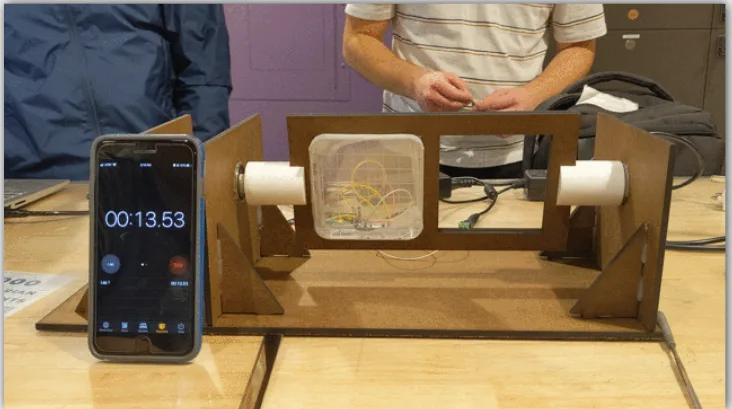
The laser-cut clinostat turning four petri dishes next to a phone running a timer
Client
Dr. Richard Barker, UW–Madison botany lab
Years
2019–2020
Area
Space
Speed
1 RPM, one full turn a minute

The problem

Space research, on Earth

Scientists still have a lot to learn about how life can survive in space, but testing in space or on other planets is very costly and often impractical. That is why Dr. Barker and his team asked Insight Wisconsin to design and build a 2D clinostat for UW–Madison’s botany research lab.

A clinostat removes the effect of gravity on plant root and shoot growth. It simulates a weightless environment without leaving Earth’s atmosphere.

The clinostat must

  • Rotate at a continuous 1 RPM for a week
  • Use a single stepper motor to drive the rotation
  • Hold at least 4 petri dishes
  • Reuse as many materials as possible

It should also

  • Be robust enough for everyday wear and tear
  • Keep outside stimuli to a minimum, including vibration and light
  • Be easy to operate
  • Be as compact and simple as possible

How it was built

Step by step

2019–2020Concepts

Clamps, bevel gears and packing

The team sketched several ways to hold and turn the dishes: a direct-drive concept with clamps as petri dish holders, a bevel gear concept that could hold a theoretical total of 8 petri dishes, and packing methods to save table space.

Direct drive, bevel gears and three packing methods.

2019–2020Proof of concept

Validated in CAD first

After narrowing down the ideas from brainstorming, the team designed and simulated a model to validate the idea before building anything.

The proof-of-concept model.

2019–2020Final design

Laser-cut in the Makerspace

The team modelled the final CAD and cut the housing and the petri dish carriage from MDF on the laser cutter in the Makerspace.

3D-printed adapters in tough PLA link the motor shaft to the carriage. They sit inside bearings on either end, which take load off the motor and keep everything aligned. After a dry fit and a spin test, the stepper motor was connected to a central control circuit for the first official test.

Built from

  • Laser-cut MDF frame
  • 3D-printed tough PLA bearing adapters
  • Bearings on either end
  • One stepper motor and a central control circuit
Final design.
Frame: laser-cut MDF.
Assembly: dry-fit test.
Bearing adapters: 3D-printed tough PLA.

2019–2020Testing

A quarter turn in 15 seconds

The stepper motor is precise (±0.09°), but the team still tested how consistent the rotation was at 1 RPM by running the device against a timer: a quarter turn in 15 seconds, which makes 60 seconds for a full turn.

The device ran for an extended period at 1 RPM during prototyping. It had not yet run for a full week because of time constraints, but the results were promising.

Tested

  • Four petri dishes filled with agar stayed seated: passed
  • The motor was strong enough to hold them: passed

Learned

  • Vibrations run through the device. It was modified to stand on its end, so it can be seen whether the seeds grow differently because of the vibrations
  • The first stepper driver was noisy. A new one reduced the noise significantly
Timing the rotation.

Next steps

What comes next

As listed by the team at the end of the project.

  1. Add an LCD screen and a potentiometer to set the rotation speed and run time
  2. House the electrical components to save space and look cleaner
  3. Build the frame from non-rusting, non-hygroscopic materials such as stainless steel
  4. Build an enclosure with lighting to control how much light the plants get
  5. Remodel the bearing adapters to reduce vibration from the stepper motor
A future version with a sturdier frame.

Credits

Who made it

Team

Yen Hau Ng, Kissak Sarajian, Maya Shoval, Zachary Stange

Client

Dr. Richard Barker, UW–Madison botany lab

Thanks to

  • Dr. Richard Barker and his lab, for enlisting and guiding the team

Poster

The original project poster. Select to enlarge.