Skip to content
All projects

Space2016–2017

3D Clinostat

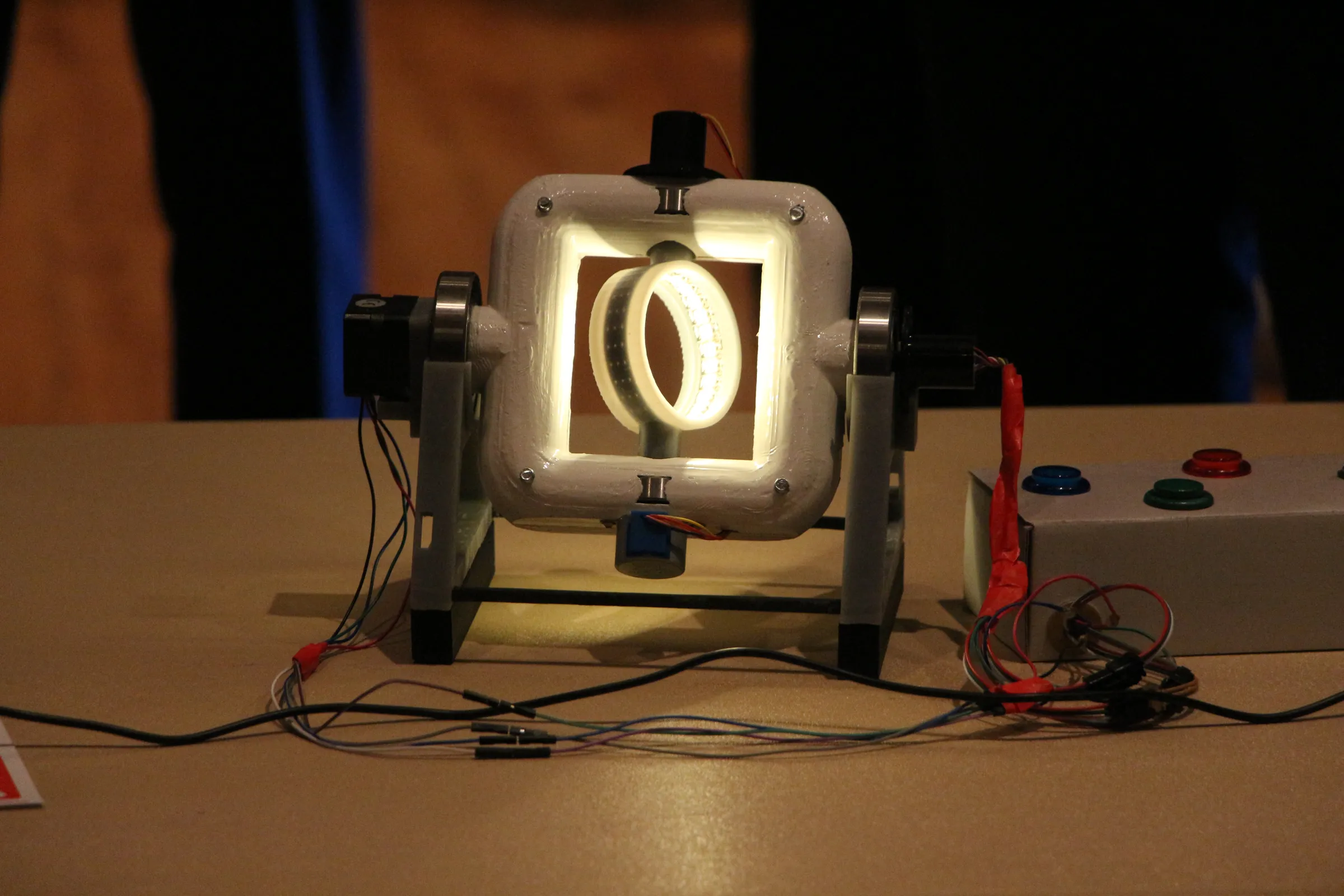
A frame that spins plant samples on three axes in constant, smooth motion, simulating microgravity for research on Arabidopsis thaliana.

The 3D clinostat glowing on a dark stage
Clients
Dr. Simon Gilroy & Dr. Richard Barker
Years
2016–2017
Area
Space
Axes
Three

The problem

Simulating microgravity

A 3D clinostat is a frame that spins in every direction, rotating organic matter in constant and smooth motion to simulate microgravity. The clients use it to study how the plant Arabidopsis thaliana grows without a fixed direction of gravity.

Goals

  • Low cost
  • High predictability
  • Smooth motion
  • High precision

How it was built

The build

2016–2017Design process

Frames inside frames

A capsule frame turns inside an external rectangular frame, which turns on rotating bases on a PVC post.

Built with

  • CAD and 3D printing for the frames
  • An Arduino Uno as the base for the code
  • Bipolar stepper motors: a 28BYJ and a Nema 14
  • Slip rings and bearings for smooth rotation

Challenges

  • Getting the most out of the 3D printers
  • Wiring and integrating the motors
  • Smooth rotation
  • Programming and controlling motor speeds
The parts of the clinostat.
Line drawing of the frames.
A printed hub.
Frame parts.
The post.

Credits

Who made it

Team

Brianna Murphy, Timothy Koll, Alexander Koller, Samuel Crowell, Shawn Zhou, Ruochen Wang

Client

Dr. Simon Gilroy & Dr. Richard Barker