Skip to content
All projects

Community impact2019–2020

Biomass Briquette Machine

A stool that doubles as a press. Body weight compresses sawdust and farm waste into briquettes that can be burned instead of wood, designed for Kenyan communities with Merry-Go-Strong.

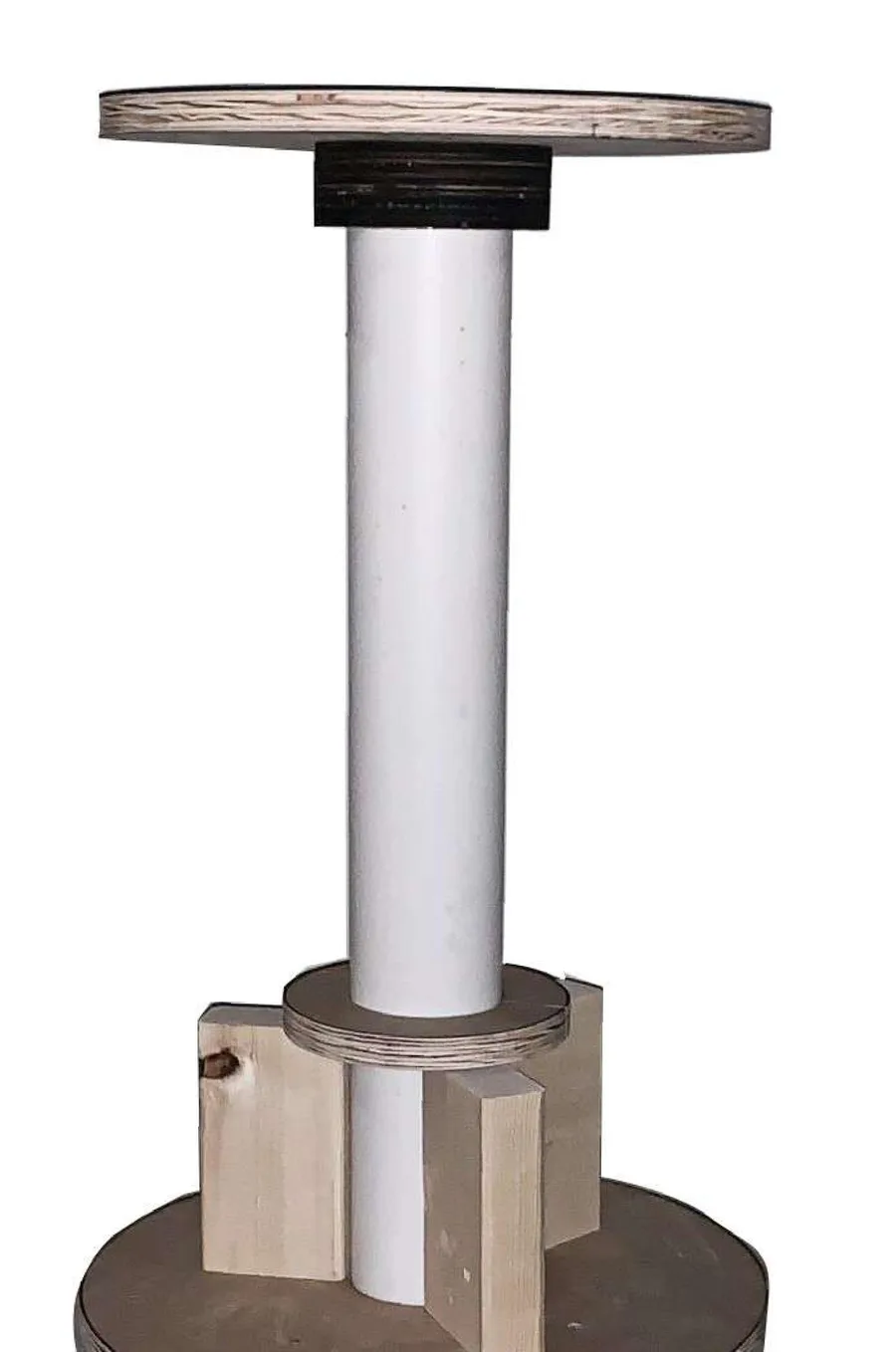
The first prototype: a plywood stool on a PVC pipe column
Client
Prof. Lesley Sager, Merry-Go-Strong
Years
2019–2020
Area
Community impact
Prototype
Built with the help of Delve

The problem

Fuel that is not a forest

Kenya loses about 12,000 hectares of forest each year through deforestation, primarily due to the conversion of forests to agriculture or development projects (KFS, 2010).

A biomass briquette is a dense brick of agricultural material and sawdust that can be burned for energy in low-resource environments. The project set out to help slow deforestation with a machine that makes briquettes to burn in place of wood.

The client, Professor Lesley Sager of UW–Madison, and her foundation Merry-Go-Strong emphasize the involvement of women and children in Kenyan communities.

From forest to briquette.

How it was built

Step by step

2019–2020Design considerations

Body weight as the press

The priority was enough pressure to make dense briquettes. Using body weight as the compression meant the stool could also be used in daily life, including weaving, a big part of Merry-Go-Strong.

The design had to be intuitive, easy to understand from pictures or actions, and built from materials that are available in Kenyan communities with limited resources.

Client requirements

  • Pressure: enhance the pressure from an average 150 lb Kenyan woman
  • Transport: mostly wood, a PVC pipe and a few nails
  • Ease of use: intuitive and adaptable to Kenyan culture
  • Durability: structural and material stability
  • Cost: value-engineered to save material and manufacturing time
The team’s Kenya mood board.

2019–2020Phase one design

Two stools

The team came up with two initial solutions.

The Kenyan Inspired Weight Stool considers the culture and people of Kenya, with the emphasis on durability and easy transport: it can be rolled. The Body Efficiency Press Stool is a modern press that is efficient, can be taken apart easily and takes less material to make a greater compression system.

The briquettes: the most common biomass in Kenya is millet, sorghum, maize and sawdust, ground and bound with lignin, clay and starch. The mixture sits for 1 hour before it is compressed in the stool, then dries for about 5 hours.

Kenyan Inspired Weight Stool.
Body Efficiency Press Stool.

2019–2020First prototype

PVC, plywood and a burn test

With the generous help of Delve, the team built the first prototype from PVC pipe and plywood.

The first briquettes were made from sawdust and water. Briquette 1 used a ratio of 1 to 5, Briquette 2 a ratio of 1 to 2. Both sat for one hour. Briquette 2 burned twice as long as Briquette 1.

Advantages

  • Little material used
  • Easy to make
  • Easy to transport: it can be rolled

Disadvantages

  • Unstable and too tall
  • The Kenyan design culture was lost

Burn test

  • Sawdust and water
  • 1:5 versus 1:2
  • The 1:2 briquette burned twice as long
The first prototype.

January 2020To Kenya

Taken to Kenya

Professor Lesley Sager brought the prototype to Kenya in January 2020, so further work would focus on adjusting the design to what was learned there.

Next steps

What comes next

As listed by the team at the end of the project.

  1. Refine the briquette recipe to get the most energy out of each briquette
  2. Test different briquette shapes and how they influence burning
  3. Make more briquettes at a time without changing the force applied

Credits

Who made it

Team

Michael Yee, Abby Lawrence, Taylor Rosenthal, Nina Sugaya

Client

Prof. Lesley Sager, UW–Madison, and Merry-Go-Strong

Thanks to

  • Prof. Lesley Sager, University of Wisconsin–Madison
  • Jesse Darley, Delve
  • Matthew Poster, Delve
  • Clay Mehnert, PE, BB7
  • Dr. Richard Barker

Poster

The original project poster. Select to enlarge.